





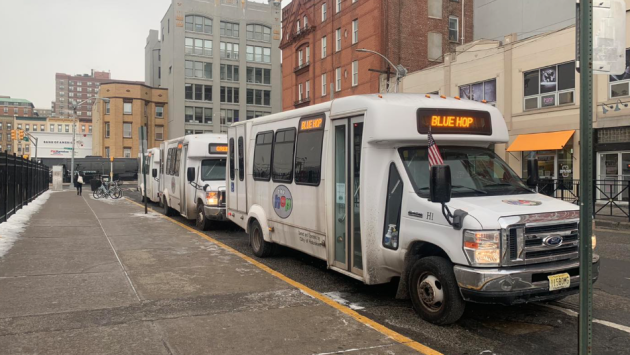


In an editorial, Jersey City resident Kevin Davis says that the Hoboken Hop study rejected by the City Council in December isn’t gone yet, citing emails sent after the vote that were obtained via an Open Public Records Act (OPRA) request.
Remember when the Hoboken City Council voted down the proposed Hop shuttle study?
New emails obtained through a public records request I filed show that within hours of that vote, city officials began discussing next steps with the consulting firm involved about how the proposal might move forward in the future.
In one message sent less than two hours after the vote, a city official wrote, “Unfortunately, the council did not approve this contract … I’m happy to set up a call this week to discuss their feedback and our options for moving the study forward early next year.”
Minutes later, the consultant replied, “We look forward to learning the feedback and next steps… We’d be glad to meet this week.”
The contract had failed by a single vote.
One of the consultants, Clayton Lane, who would have worked on the study is a founding trustee of Bike Hoboken and currently serves on the board of Hudson County Complete Streets, organizations that have publicly advocated for transportation policies in Hoboken.
Those affiliations were not referenced in the proposal biography provided with the contract materials.
Other emails add context. When asked whether other firms had been solicited, a city official responded, “No, we have not.” In another message, the same official wrote, “This contract would be approved before the new mayor is inaugurated.”
A detailed staffing breakdown was later provided to city staff, but was not included in the public agenda packet council members received before voting.
Emails also show that before the Hop study was selected, Clayton Lane shared several other proposed project concepts with city officials, including a “Citibike Renewal Advisory,” “Strategy & Policy Support into New Administration,” and a “Corner Car Program Refresh.”
Proposing ideas to municipalities is common practice for consulting firms. However, the inclusion of a bike-share advisory proposal is notable in light of public advocacy positions taken locally.
For example, Bike Hoboken has written that “whether or not to continue Citi Bike isn’t a serious debate” and that the key question is how much the program should be expanded. That does not suggest any impropriety.
But it raises a reasonable transparency question: when proposals involve policy areas where advocacy groups have publicly taken positions, should any relevant affiliations or roles be disclosed before decisions are made?
You ever notice how public process sometimes seems to happen privately first?
None of these facts, by themselves, prove anything improper occurred. But together they raise reasonable questions residents and officials may want answered. Should a policy study be offered to multiple firms rather than just one?
Should affiliations with advocacy organizations be disclosed when the work involves related policy issues? Should major studies be scheduled for approval during a transition between administrations?
And after council votes no, what is the standard for bringing a proposal back?
Another recent development adds context. The city announced this week that Ryan Sharp, who previously served as Hoboken’s transportation director, is returning to lead the department again.
With experienced leadership and professional staff already in place, it raises a practical question: does a study like this need to be outsourced at all?
Many municipalities conduct preliminary evaluations internally before determining whether outside consultants are necessary.
Considering that option first could help ensure public funds are used efficiently and that any future contract is limited to tasks the city truly cannot perform in-house.
Government transparency is like Wi-Fi, you don’t notice it until it stops working. I fully support transparency. I would just like to see it.
This issue is larger than any one consultant or one proposal. It is about public confidence in the process.
When cities commission studies that may shape future policy, residents expect procedures that are transparent, competitive when possible, and fully disclosed before votes take place.
If the Hop study is reconsidered, a straightforward approach could address many of these concerns: open the process to multiple proposals, disclose relevant affiliations, and provide complete information from the start.
Public trust depends not only on whether decisions are made correctly, but on whether the process makes that clear.
Kevin Davis
Jersey City, NJ
Hudson County View
Comments
Spotify Beats MLC Audiobook Lawsuit After Judge Calls Federal Royalty Rules